Hong Kong contact. Mainland China manufacturing.
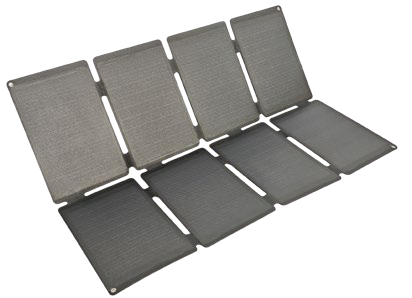
60 W Folding Solar Charger with USB-C PD Output — product imageEnlarge image
60 W Folding Solar Charger with USB-C PD Output — product image, enlarged
Reference image. Appearance and markings are confirmed for the selected model.
Solar Components

60 W Folding Solar Charger with USB-C PD Output

Catalogue selection · confirm the orderable model

An eight-panel portable solar charger with a 60 W array rating and a listed 20 W maximum USB-C PD output, for device-power evaluation.

Solar array rated power
60 W ±3%
Maximum-power voltage (Vmp)
21.31 V ±3%
Unfolded dimensions
760 × 566 × 20 mm (±2 mm)
Folded dimensions
283 × 187 × 45 mm (±2 mm)

Sample availability, pricing and shipping are confirmed for your configuration. Specifications are manufacturer-stated.

Specifications

60 W Folding Solar Charger with USB-C PD Output specifications
ParameterStated value
Solar array rated power 60 W ±3%
Maximum-power voltage (Vmp) 21.31 V ±3%
Unfolded dimensions 760 × 566 × 20 mm (±2 mm)
Folded dimensions 283 × 187 × 45 mm (±2 mm)
Net weight 1.3 kg ±0.2 kg
USB-C PD output (listed configuration) 20 W maximum

Values are taken from manufacturer documentation and apply to the listed configuration. Confirm the current model-specific document, conditions and revision before procurement.

Integration notes

Mechanical and electrical fit

Review available area, mounting support, loading, shading and the receiving electrical system. Confirm handling and installation limits for the selected module; a thin profile does not define permitted bending.

Application notes & selection checklist

Compare array power and USB-C output separately

The solar array is rated at 60 W, while the listed USB-C PD configuration has a 20 W maximum output. The array rating is not a 60 W USB-C charging specification. Match the actual output protocol and receiving device before treating this charger as a suitable portable power option.

Plan for carrying and deployment

Review both the folded and unfolded dimensions. They answer different questions: whether the charger fits the transport space, and whether the user can expose the array in the intended working area. Confirm handling requirements and the supplied cable/connector configuration for the selected version.

Make the device test specific

  • Identify the device, cable, input protocol and selected output port.
  • Request per-port and simultaneous-port limits instead of adding connector ratings together.
  • Record exposure and charging behaviour under representative use conditions.
  • Keep solar-side observations separate from the output delivered to the device.
Samples & customization

Share the interfaces, mechanical envelope and changes you need. We coordinate the review of feasibility, sample configuration, minimum quantities, tooling and commercial terms. Agree on the test scope and responsibilities before evaluation.

How we approach validation

Documentation

Model-specific datasheet

Request the current datasheet, interface information and revision for your project.

Request the datasheet

Applications to review

These paths help frame a review. A listed component is not a pre-validated system configuration.